
We all, both men and women, follow the same pattern, with differences due to individual sensitivities and with timelines which vary from person to person, but our beginnings and our ends are the same and it is possible to predict our course, by the decade.
AREN’T THE 20S MARVELOUS?
My skin is clear, the zits are gone.
Every race I’ve run, I’ve won!
When they say, “jump high”, I leap.
Why do elders need more sleep?
We all have 10 fingers and 10 toes [well, most of us: there is a tribe in Africa, many of whose members have six digits per limb]: this accounts for the decimal-based numerical system, which in turn is the reason for our predilection for a decade–based way of thinking about time.
It seems serendipitous however, that our changing attitudes and abilities can so conveniently be attributed to one or other “decade”. Thus 1-10 is the decade of the child, 11-20 the decade of the developing adult, decade 21-30 that of the young adult, of fully fledged abilities, still inquiring but capable, confident and outgoing, healthy and problem-free.
The third decade is a time of personal optimism [tempered perhaps by social pessimism], a time of planning and preparation, a time of enjoyment and procreation. For most of us, this is a time of smooth progress when no Mountain seems too high to climb, no Sea too wide to navigate; but then, there comes the fourth, which for many of us, begins with a wrenching sense of insecurity!
THE DIRTY THIRTIES
Oh, it’s been great, these last ten years!
Why do I have these strange new fears?
My zits are back! I feel so dirty!
Is this still me? I’m only thirty!
Atitudes vary: ……… “life begins at 40” – “I want to retire by 50” – “freedom 55” – “60 is the beginning of old age” – “mandatory retirement at 65” – “how did I get to be 70?” – “you can’t be 80 – you don’t look a day over 60!” ……….. But for many of us, 30 is a watershed year: a career has been chosen (or forced upon us); children are growing, or being seriously contemplated; burgeoning problems of marriage, work schedules, social networking, financial planning, child schooling, housing and myriad other considerations begin to get in the way of social, psychological and physical self-care.
Stress rises as the hormones fall 2% per year. Both men and women lose hair and gain weight. For some, acne raises its ugly head (again) and for many, a strange lassitude, bordering on ennui, slows life down. Any tendency to depression, panic attacks or pessimism balloons and can become a difficult burden.
It seems to some of us that either life has changed, or we have.
THE NAUGTY FORTIES
Hey, look at me: I’m only 40!
Hey, I’m still young and I’m still naughty!
No need to ask: I’m free, of course.
My hangups went with my divorce!
Another watershed: for many men, the flowing hair is no longer missed and for many women, continuing hair loss has begun to seem normal.
The fragile fingernails are a nuisance, but what can you do?
The psychiatrist says that depression is a natural response to life’s difficulties and the therapist says that all you need is retraining.
The Doctor and the dietitian are unable to explain why your spare-tire persists in spite of diet and as much exercise as you can find time for.
The partner can’t understand why you spend so much on makeup and the hairdresser seems congenitally unable to understand what your hair color is supposed to be.
Well, never mind: all your friends have some kind of problem and yours aren’t so bad, really – the fat lady around the corner is going to have her hip replaced and even that superfit, squash-player friend has trouble with his knees.
And why worry? – your new boyfriend/girlfriend loves you more than your spouse ever could have and who cares if s/he isn’t all that interested in making love? – You’re not so interested yourself, anymore!
THE NIFTY FIFTIES
I’m not so bad: I’ve still got looks!
The kids have left – they’re off the books!
I like your style: give me a tumble
I love to dance, baby; let’s rumble!
So now you’re 50: it’s not as bad as you thought it was going to be; inside, you still feel like 30 and although your income hasn’t gone up much, you have so much more to spend because the kids don’t need it anymore and the smaller house is so much more economical!
It would be a bit better if your waist were smaller and you didn’t have the cholesterol problem, the diabetes and the high blood pressure, but the doctor says that as long as you keep taking your medication, all will be well. S/he doesn’t know about the antidepressants of course: you’re doing all right, according to the psychiatrist.
THE SICKISH SIXTIES
Her heat now only comes in flashes.
His member rises, then it crashes.
Who needs a man? They’re all so fake!
She isn’t funny: she’s a flake.
60: I made 60!
Retirement in five years!
Funny, I still feel like 30 inside.
And I’m fine, once I get going – I kind of wonder why I’m so stiff in the mornings though: maybe the backache’s because we need a new mattress, but what’s the reason for my fingers being so crampy?
Anyway, life begins with grandkids, right? – I just love young Mark; man, can he throw a baseball – he throws so hard, it hurts to catch!
Okay, no more doggerel: everyone’s familiar with this story. I’m sure it wasn’t really necessary to tell it, but it does set the mood for questions: Why does it have to be this way? Is there a way around the problem or at least, can we make life a little easier? Where can I find information? And the answers are: (1) we are designed with a certain life expectancy and programmed to deteriorate over time. (2) yes, there is a way. (3) see the notes below.
Although currently, it is not possible to explain the root cause of the cascade by which we lose first our abilities and then our faculties, the sequence of events is becoming clearer as more information is posted to the online literature.
EVERYBODY DOES THEIR THING Every cell in the body operates an internal factory for production of its own, locally acting neurosteroid micro-hormones: this is called ‘Intracrine’ function and its study is termed ‘intracrinology’.
THE STEROID SYSTEM Believe it or not, our hormonal system begins with cholesterol and believe it or not, we begin to shut the system down at age 25.
SO LET’S TAKE A LOOK AT THE “STATE OF AFFAIRS” First of all, there are things we know. Then, there are things we don’t know. There are effects which we partially understand. There are effects of which we know nothing.
UNDERSTANDING THE BASICS
The designated CEO of the entire hormonal organization is the hypothalamus: http://en.wikipedia.org/wiki/Hypothalamus.The hypothalamus is responsive to:
Olfactory stimuli, including pheromones,
Blood-borne information: hormones, toxins, enzymes, auto-control chemicals from the kidneys, pancreas, stomach and other parts, blood concentration, oxygen levels, emergency messages from the Adrenals and other organs, even invading pathogens,
Neurally transmitted information from central organs; heart, intestine, lungs, kidneys etc,
Heat and Cold stress,
(?) Magnetic information.
Based on information about the condition of the body and the circumstances of its situation, gleaned from these sources and its own internal “algorithm”, the hypothalamus figures out what needs to be done to keep things in balance and sends “releasing hormones” to the pituitary gland, which then relays facilitating hormones to the thyroid for production of thyroid hormone, to the adrenal glands for production of cortisone and salt-control hormones, to the kidneys for water control, to the ovaries or testicles for production of sex hormones and eggs or sperms and even to the “brown fat” and the skin, for temperature regulation.
The CPU (the brain) however is the actual/factual owner/operator and while the CEO is busy outputting instructions to the managers, the CPU is busy operating its intracrinological factory, producing “neurosteroids” for its own use and to some extent, micro-managing the Hypothalamus – more on that, later: let us begin by explaining the simpler systems….
The Pineal, a pea-sized gland in the midline of the brain, is the body’s timer, controlling the “diurnal rhythm”: it produces melatonin to set the sleep/wake cycle, restricts growth and (maybe by holding back DHEA production in the first decade) delays the onset of sexuality until puberty. It tends to stop working in the third decade because of calcification: for some reason, it progressively calcifies with the same type of calcium crystal found in the teeth and can sometimes be seen on x-rays as early as age 20.
THE THYROID: this is the simplest of the peripheral systems – the thyroid makes “T4” thyroid hormone, an inactive “raw material” with 4 iodine atoms which is converted into active “T3” hormone by removal of one iodine atom. T3 Increases the metabolic rate of the body, Increasing efficiency, optimising reaction speeds and regulating temperature and energy usage.
THE PARATHYROIDS: these multiple glands [from 2 to 8, occasionally more], situated behind and/or within the thyroid, produce Parathyroid hormone (“Parathormone”), which regulates calcium levels and speeds up the metabolism of the bones.
THE PANCREAS: this long and narrow organ, which nestles within the curve of the first part of the small bowel [the duodenum], has a head at its the right end, a body and a tail. The head and body produce juices which flow into the duodenum to digest proteins and also produces gastrin, which stimulates the stomach to make carbohydrate- splitting acid.
Located mostly in the tail, the “Islets of Langerhans” make a hormone called Glucagon, which increases the blood sugar level [by causing the liver to convert glycogen to glucose] in their “alpha cells”. In their “beta cells”, the islets make insulin, which controls conversion of sugar to glycogen, for storage.
THE OVARIES AND TESTICLES are run by two pituitary hormones, Luteinizing hormone [LH], which stimulates their production of Testosterone and Estrogen, and Follicle-stimulating hormone [FSH], which encourages the production of eggs or sperm. The ovaries produce oestrogen and progesterone and the testicles produce testosterone.
THE ADRENALS, very thin, sandwich-like “caps” which sit on top of the kidneys, make Pregnenolone from cholesterol and then uses the Pregnenolone to make a range of hormones: Testosterone and related androgenic hormones,
Progesterone and related hormones,
Estrogen and related hormones,
Hydrocortisone and its “glucocorticoid” relatives and Aldosterone and its “mineralocorticoid” relatives, the salt-control hormones which are active in the kidneys.
The adrenals’ main output however is DHEA, produced for the body in general as raw material for steroid hormone production: this they do on their own, without instruction from the Pituitary or any other gland and with no feedback mechanism to reduce their output.
THE KIDNEYS produce Renin and related hormones, to control the blood pressure, this is essentially, a matter a matter of self-interest for the kidneys, since their main interest in maintaining blood pressure is to ensure an adequate blood flow for themselves.
NOW TO THE CRUX OF THE MATTER, THE COMPLICATED PART OF THE STORY:
So as to foster understanding, let us view the body as an orchestra – the individual players mentioned above are relatively sedate, slow and steady in their function, but the body as a whole must be ready to respond to emergency situations of one sort or another – rapid, maximum-effort locomotion for hunting, avoidance of danger etc., shutdown of various systems in response to injury, defense against invading organisms and accomodation for sudden changes in the environment, as well as CPU responses to threatening situations and CPU glitches. In addition, [perhaps of most interest to us humans] the body’s individual parts must be ready and willing to kill abnormal cells [a process called apoptosis] before they can reproduce themselves.
There also needs to exist, some mechanism for repair and maintenance of the various cells, including the cells which make up the CPU, the CEO and the hormone-producers.
Therefore there is, as you would expect, a general director: a conductor, if you will. This service is performed for the body as a whole by the Hypothalamus, but in fact every little cell within the body runs its own system of maintenance and repair, synthesizing its personal mix of micro hormones from DHEA, which is generously supplied by the adrenals in youth, but is less and less available as the years progress.
It is becoming clear that the supply of DHEA is central to efficient function for all parts of the body, from the hair roots to the nails on the fingers and toes.
Without DHEA, only the fat cells function normally: the glands begin to ignore the signals from the conductor, the muscles become flabby and the bones become thin, the skin loses turgor and elasticity, the eyes become dim, the pancreatic cells malfunction, the electrical conductivity of heart muscle decreases, the facility for apoptosis is lost in one or another part depending on the individual’s tendency to some particular cancer, the personality loses self-confidence and even the libido begins to fail: in short, the entire system goes “haywire”.
SO, LET’S TAKE A LOOK AT THE ORIGINS OF DHEA: FIRST, THE ADRENALS.
The Adrenal glands are fascinating in terms of their structure as much as their function.
Each looks like a little cap, set on top of its kidney.
Each has an inner layer called the medulla, which produces emergency response, kidney-control and blood pressure hormones and an outer layer called the cortex, which converts cholesterol to pregnenolone and then changes the pregnenolone into multiple active products, as indicated in the flowchart below.
In youth, the Adrenals produce huge quantities of DHEA: by weight, more DHEA is produced than all the other hormones together!
At the age of 25 however a progressive reduction of DHEA output begins: we reduce production by 1% or 2% per annum, so that by age 80, our serum levels of DHEA are 20% or less of what they were in our second and third decades.
The reasons for reduction of DHEA production are unknown; but as implied above, perhaps the decline of the “third eye”, the pineal gland, leads to deconditioning of a feedback mechanism which controls DHEA production by the adrenals.
CONVERSION OF CHOLESTEROL TO ACTIVE STEROIDS
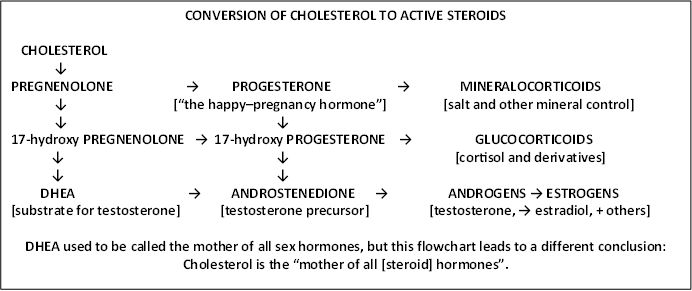
A quick review of the flowchart will lead you very quickly to my conclusion:
CHOLESTEROL is the “grandmother of all [steroid] hormones”.
What is not evident from the flowchart, is that Progesterone [via Conversion to Allopregnanlolone] and Testosterone are particularly active within the brain and central nervous system, raising levels of mood, self-awareness, self-esteem and empowerment, while the glucocorticoids, cortisol being the principal one, which are produced as part of the body’s emergency response, tend to lower mood, self-awareness, self-esteem and empowerment.
Also not evident is that processing, of Pregnenolone to Progesterone, of Progesterone to Allopregnanolone and of DHEA to Testosterone, is performed inside every individual cell, including brain and nerve cells, and not by the Adrenal glands themselves.
This is termed “Intracrinology” (See the article regarding Professor Fernand Labrie).
Thus the brain, like the rest of the body, processes Pregnenolone and DHEA, which are inactive, to produce its own supply of Testosterone, Progesterone and their downstream hormones; the active hormones which are needed for maintenance and repair.
The brain however, is unable to produce enough of the raw materials, Pregnenolone and DHEA.
It needs an external supply and just as the rest of the body deteriorates as the raw material supply reduces with age, the brain is increasingly unable to manage its maintenance and repair systems as production falls.
Thus a deficiency of DHEA and Pregnenolone leads to deficiency of Testosterone and Progesterone (and the all-important ALLOPREGNANOLONE, made from Progesterone),
with down-regulation of the brain’s internal psycho-support system, lost rapidity of thought, reduction of perception, lowered self-confidence and “fuzzy” conceptualization.
Ironically Cortisol, which is undeniably an excellent remedy for the physical manifestations of the autoimmune conditions which result from underproduction of DHEA and Pregnenolone, produces further psychological deterioration, reduction of self-confidence, depression etc..
In youth, the Adrenals produce huge quantities of DHEA: by weight, more DHEA is produced than all the other hormones together!
At the age of 25 a progressive reduction of DHEA output begins: we reduce production by 1% or 2% per annum, so that by age 80, our serum levels of DHEA are 20% or less of what they were in our second and third decades.
The reasons for reduction of DHEA production are unknown; but as implied above, perhaps the decline of the “third eye” (the pineal gland), leads to deconditioning of a feedback mechanism which controls DHEA production by the adrenals.
But let us examine the production of Pregnenolone, the “mother of all sex hormones” and its offspring.
Pregnenolone is chemically modified to yield multiple active products, the first of which is Progesterone, but the premier of which is DHEA [originally, DHEA was viewed as the mother of all sex hormones].
PROGESTERONE:
An enzyme system changes Pregnenolone into Progesterone, the “happy pregnancy hormone”.
Progesterone itself tends to produce weight loss by an increase in the metabolic rate and protects the breast, colon and some other tissues from the development of cancers.
An adequate supply of Progesterone is required to “balance” the Estrogens, for normal menstrual cycles, ovulation, implantation of fertilized ova and progression of normal pregnancy.
“Downstream”, Progesterone is processed to:
[1] Allopregnanolone, which is a direct product from Progesterone is the actual reason for the “happy” in “Progesterone, the happy pregnancy hormone” it subserves central nervous system maintenance and repair, works as a “sleep hormone” [in concert with Melatonin], promotes clear cognition and memory and increases the sense of self-satisfaction and optimism.
Allopregnanolone deficiency is the cause of post-partum depression and most cases of depressive psychosis.
[2] “Mineralocorticoids”, which control salt and water balance through the kidneys; thus Progesterone works as a diuretic [water excretion] trigger.
NOTES ON TESTOSTERONE:
Testosterone is primarily responsible for normal development of male sex characteristics and reproductive organs, including the penis, testicles, scrotum, prostate, and seminal vesicles.
It facilitates the development of secondary male sex characteristics such as stronger muscles and bones, male fat and hair patterns, and the larger larynx which produces the male voice.
However Testosterone works in concert with oestrogen to maintain muscles, bones, energy level, healthy mood, awareness, quick reflexes and sexual desire in both males and females.
Particularly, Testosterone maintains heart muscle and is the reason for the lowered rate of heart disease in people who take DHEA.
Since testosterone is produced directly from DHEA, progressive DHEA deficiency results in reduced testicular Testosterone production, with reduced Muscle mass, slowing reflexes, loss of self-confidence (with resultant increase in anxiety), loss of libido and slowing cognition.
DHEA supplementation facilitates a return of Testosterone production via whole-body intracrine synthesis and is capable of stimulating production to supranormal serum levels.
It is interesting that Testosterone deficiency is prevalent among the patient population afflicted by a long list of chronic conditions, including obesity, diabetes, hypertension, hypercholesterolemia, autoimmune diseases of various types [for example lupus, rheumatoid arthritis, ulcerative colitis, and D.I.S.H.]. It is particularly interesting that low levels of serum Testosterone and DHEA are found in individuals with cancers of the prostate, breast, colon, bone marrow and many other organs.
There is a dose-related “downside” for each sex (wouldn’t you know it): oversupply of Testosterone in females can cause facial hair growth and in men, any surplus can undergo conversion to Oestradiol, with breast enlargement and even the dreaded breast cysts !
However these side-effects disappear within a few days when the dose of DHEA or Testosterone is lowered.
NOTES ON ESTROGEN
There are 3 “flavors” of estrogen:
[1] Estradiol, the “working estrogen”, subserves distribution of adiposity to the female secondary sex characteristics, generally including the “Coca-Cola bottle areas”, normal bone metabolism, skin, hair, fingernail, Vaginal and urethral homeostasis and support of the menstrual cycle. A shortage of estradiol is the prime factor in osteoporosis, which kills more lady “seniors” than any other pathology.
[2] Estriol, the “protective hormone”, is active in retarding production of breast, colon, ovarian and other cancers.
[3] Estrone, the “baddie”, comes in 4 forms, 2 of which encourage the formation of cancers, particularly breast.
An imbalance of production, between estrogen and progesterone results in menstrual cycle disruption, dysmenorrhea and many of the symptoms of menopause.
NOTES ON THE SCIENTIFIC INVESTIGATION OF DHEA
The 20th-21st century investigative instrument, the ten-thousand-patient, double-blinded, p-value studded, NNT [“Number Needed To Treat” to produce one Cure] – embellished, armour-plated superstudy is admirable in intent, elegant in logic, insuperable if well constructed and necessary to this age of legalistically-oriented medicine.
However it has its flaws: it is too expensive, necessitating massive financial support from vested interests. It is liable, by virtue of its complexity, to the problem of obsolescence-before-completion. It asks huge numbers of placidly compliant sufferers to accept the possibility that the therapy they desperately need may not in fact, be therapy at all; they may receive the dreaded “Placebo”, depending on the luck of the draw.
Perhaps the most unjust aspect of this paradigm of ours is that such emphasis is put on super-expensive studies that our “vested interests” have become, de facto, the principal initiators and drivers of much of our research.
These perhaps are among the reasons why DHEA, which was discovered in 1936, which has been the subject of a very large number of animal studies, whose effects are promising in many dimensions (including cancer prevention), whose production cost approximates that of aspirin and whose side effect profile is entirely benign [there have been no reports of significant side effects in the United States, despite the fact that it has been available over-the-counter there since 1995], has not been fully investigated in a clinical setting, in spite of the 70-year-plus history of public interest in its properties.
Perhaps also, these are the reasons why the websites of the American superclinics uniformly manifest the opinion that the beneficial effects of DHEA (and other natural, non-Patentable, compounded Bioidentical hormonal substances “have not been adequately studied and therefore cannot be recommended”).
IT’S TIME FOR A PARADIGM SHIFT !!
 Hormone Therapy Explained