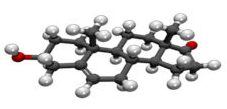

PROGESTERONE
The hormonal action of progesterone was discovered in 1929, following the discovery of estrogen in 1923.
Progesterone must not be confused with “progestins”: progestins are pharmaceutical chemicals, either completely synthetic or made from horse’s urine, which possess properties similar to those of progesterone but which are known for their propensity to promote breast and uterine cancers, large vein blood clots, heart attacks and strokes.
In the human body, progesterone is produced from pregnenolone, which is made by conversion of cholesterol.
This human hormone is produced in very large quantity by the ovaries, the placenta and even the brain, but bioidentical progesterone (a substance with a precisely identical chemical structure) can be produced pharmaceutically, from “diosgenin”, a chemical found in wild yam which can also be processed into the entire sequence of human “neurosteroid” hormones.
PROGESTERONE IS ACTIVE IN MANY HUMAN BODY SYSTEMS
Progesterone normalizes the menstrual cycle and is necessary for pregnancy.
It improves kidney function.
It opposes the natural tendency of oestrogens to produce weight gain, so it is sometimes prescribed to improve the progesterone/oestrogen balance, to help with weight loss.
In the brain, Progesterone changes into Allopregnanolone, which promotes normal sleep patterns, helps to control pain, enhances self-image and is the main hormone responsible for brain maintenance and repair.
Males produce little progesterone and after menopause/andropause, neither men nor women make enough.
Progesterone deficiency causes menstrual irregularity, PMS and infertility in women, and in both sexes it is a cause of insomnia, poor self-image and a loss of “tranquility”.
Especially when combined with other deficiencies, it is a cause of depression, fuzzy thinking, memory loss, confusion and possibly, Alzheimer’s disease.
A nightly dose of progesterone, taken with melatonin, maintains levels of progesterone in the brain, to take advantage of the benefits of the hormone: in particular, in assisting with brain maintenance and repair.*
Low Progesterone can start at any age, in both women and men.
Some practitioners believe that by promoting brain maintenance and repair, adequate progesterone levels prevent, or retard, development of Alzheimer’s and other neurological diseases.
*Progesterone, if administered quickly after a stroke, concussion or brain/spinal-cord injury, minimises nerve cell damage.
PROGESTERONE IN THE MENSTRUAL CYCLE
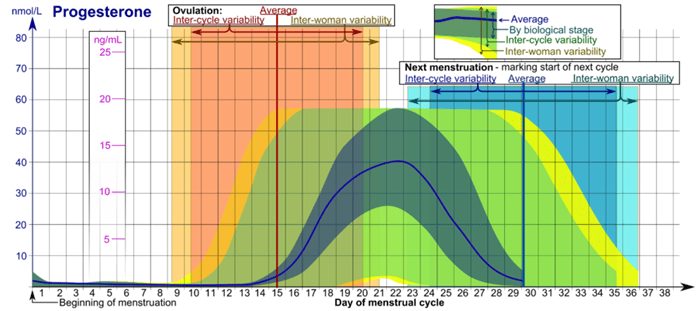
In men, and in women during the 7 to 10 days of the menstrual cycle, the progesterone level is low (< 6 ng/ml)**.
After ovulation production rises rapidly to 30 – 50 ng/mL and if pregnancy occurs, a hormone, “HCG”, or “human chorionic gonadotropin” is released by the fertilised egg. HCG converts the egg sac in the ovary into a “corpus luteum”, which produces progesterone to maintain the pregnancy until the placenta begins to produce its own progesterone at 7–9 weeks. The placenta keeps producing large quantities of progesterone (100–200 ng/ml) until a day or two before the baby is born: once the placenta is “birthed”, the woman’s blood progesterone level falls and stays down until she is finished breastfeeding.
**It has been suggested that women have better memories than men do because they make more progesterone.
PROGESTERONE DEFICIENCY
Progesterone deficiency normally does not begin until menopause or andropause, however it can begin at any age, perhaps because of perceived stress in childhood. Any woman who suffers from PMS, menstrual irregularity, oligomenorrhoea (abnormally light menstruation) or menorrhagia (abnormally heavy menstruation) should have her “peak” blood progesterone levels checked between the 20th and 22nd day of her cycle, so that consideration can be given to treatment with progesterone.
PROGESTERONE PREPARATIONS
Progesterone can be prepared as a cream, sublingual tablets or troches. Some practitioners prefer creams, but usually it is prescribed as capsules, which are more convenient to take, are guaranteed to be of uniform dosage and are not liable to transfer to a partner as a skin cream is.
The usual dose of capsules is 100 – 300 mg for woman and 50 mg for men. The dose of cream is usually only 1/3 of the oral dose, because progesterone absorbed transdermally enters the circulation immediately, while material absorbed from the bowel passes through the liver, which destroys perhaps 60 % of the dose.
Progesterone is taken an hour before bedtime, with 3 – 20 mg of melatonin: of the two, progesterone is the better sleep promoter because Allopregnanolone made from the progesterone is what puts you to sleep (melatonin is prescribed for its multiple functions, which include assisting Allopregnanolone with brain maintenance).
PROGESTERONE SIDE EFFECTS
There are no side effects from progesterone, but it makes some people feel slightly groggy in the morning: if so, take your progesterone earlier in the evening.
SIDE EFFECTS OF TAKING PROGESTERONE
BIOIDENTICAL PROGESTERONE: There are no side effects from taking normal, human Progesterone (see the article on Progesterone, in this website). NON-HUMAN PROGESTERONE: a number of synthetic and animal-derived “progestins” were prescribed in the twentieth century, which produced such a range of lethal and sublethal side effects , including cancers, blood clots, strokes and heart attacks, that the very word “hormone” fell into disrepute.
The guilt response of the medical profession as a whole was overwhelming: many MDs became so upset by the mention of hormone therapy that they refused even to discuss the subject. Our doctors are beginning to recover and to recognise that apart from the possibility of hormone-dependent tumours, human hormones do not present a problem.
But although it is thirty years later, doctors are still reluctant to embrace the principles of hormone therapy.
COMMON SYMPTOMS OF PROGESTERONE (PILLS):
Zero (in my experience).
Reportedly, progesterone side effects include stomach upset, changes in appetite, weight gain, fluid retention and swelling (edema), fatigue, acne, drowsiness or insomnia, allergic skin rashes, hives, fever, headache, depression, breast discomfort or enlargement, premenstrual syndrome (PMS)-like symptoms, altered menstrual cycles, irregular bleeding, and other side effects. However in my practice, the prescription of 100 – 300 mg of progesterone every night for menopausal women and 50 mg nightly for men has not to date produced any of these side effects excepting that some sensitive subjects feel groggy on waking.
SIDE EFFECTS OF PROGESTERONE CREAMS: skin irritation
ABOUT THIS MONOGRAPH
This very brief “paper” on progesterone is a condensation of quite a lot of information, especially regarding the activities and functions of progesterone in the human body.
It is intended to provide “lay” persons with the basic information they need to understand hormonal matters, cooperate with their functional medicine practitioner and make more confident decisions about their own healthcare.
If you need further information, or need a deeper understanding of your hormonal imbalances, please see “you and your hormones” ( https://www.yourhormones.info/hormones/). This is an amazingly detailed, in-depth, all–encompassing review of all the human hormones, much too complicated for the casual reader, but useful if you need it.
 Hormone Therapy Explained
