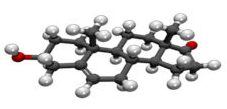

Testosterone
- Testosterone is the “male sex hormone”. The youthful male generates large quantities in the testicles, while in the female, the ovaries make 10% as much.*
- Also, in both males and females, all our cells produce testosterone locally, converting DHEA in a process termed “intracrinology” by Professor Fernand Labrie (1)
- Testosterone subserves maintenance and repair of muscle, bone, skin, sweat glands and hair; it supports the libido in both male and female. It maintains self-confidence, minimising our anxieties and shielding us from depression.
- Maximum testosterone production begins at puberty and is responsible for development of the male sex chacteristics; beard hair, deepening of the voice by enlargement of the larynx, building muscle, strengthening bones, growing the prostate and penis, etc.
- Serum Testosterone remains high through the third decade, but since it is made from DHEA, a gradual fall in production starts at age 26. Starting then, DHEA production falls 1% per year in both sexes. This is easily demonstrated in blood tests; but a 1%/year downward trend in Testosterone is hard to “see”** in men, because their “normal” blood level spans a wide range (9.2 to 31.8 Nanomoles/L) and because a man’s Testosterone level varies with the time of day (highest at 8AM) and with physical and sexual activity. Suffice it that although the testicles don’t lose function completely at “andropause”, as the ovaries do at menopause, by age 80 men’s testosterone production is down to 10-20% of what it was at 25. ALSO, to make matters worse, production of “Sex Hormone Binding Globulin” goes up: SHBG grabs onto sex hormones and inactivates them!
- In any case, the testoterone level often doesn’t match up with symptoms: many older men with “low T” are fit, sexually active and cognitively sharp, while many men with mid-normal “T” present to the MD with Low-T problems, even in their 20s.
- Women’s ovaries also produce testosterone in youth, but only 10% or so of what the testicles do and at menopause they shut down completely. In menopausal women therefore, serum Testosterone tends towards zero: all cells continue “intracrinological” testosterone production***, but production, which is dependent on DHEA supply, is so low that very little gets into the blood.
- Zero testosterone and subclinical functional hypothyroidism, presenting as hair loss, brittle nails, dry skin, vaginal dryness and low libido, are often seen in 20-to-30-year-old women. *
* Childhood PTSD from physical, mental or sexual abuse, usually unrecognised, can result in functional hypothyroidism and deficiency of DHEA, Testosterone, Progesterone and Allopregnanolone in the teen years, perhaps accounting for the depression and obesity of the “troubled teen” and setting the stage for moderate deficiency in the third decade and severe, symptomatic deficiency by the fourth.
** The best measure of the individual’s Testosterone-maufacturing capability is to estimate the DHEA level: DHEA peaks a little earlier in the AM than testosterone does, but it doesn’t “bounce around” as the testosterone level does.
Also, reduced DHEA production is easier to observe in lab tests and since it is the precursor of “T”, its level gives an accurate measure of T production.
*** Our cells have at their disposal a family of 30 (or so) enzymes, each of which converts DHEA into its own brand of “microhormone”. Each cell type employs its selection of enzymes to “mix and match” an individual hormone cocktail for its own maintenance and repair. As the DHEA supply falls, all cells begin to suffer from DHEA deficiency, but some tissues are more sensitive to “DHEA famine” than others, so the visible and symptomatic effects vary from person to person.
EVERYBODY is in the game !
We all, males and females, need, use and make Testosterone and we all, sooner or later, become Testosterone deficient, so we all develop some mix of symptoms and/or signs of hypotestosteronemia eventually. The Baltimore Longitudinal Study of Aging reported the incidence of hypogonadism **** as 20% in men over 60, 30% in men over 70 and 50% in men over 80 years of age .
**** I hate the term “Hypogonadism”: the problem is low testosterone, not low gonads !
SO: what happens in T deficiency?
(1) Nuisance-value symptoms:
Low libido
Erectile dysfunction
Fatigue.
Poor motivation
Mood swings
Body and facial hair loss
Difficulty concentrating
Depression
Irritability
Low sense of well-being ………………………….. HEY, WAIT A MINUTE !
Those are stress-related symptoms !
Those are low-DHEA symptoms !
Those are low-thyroid symptoms !
(2) High-grade problems:
- Anaemia
- Reduced bone mass and increased bone fragility
- Reduced muscle mass
- Heart “events”
- Increased obesity
- Cognitive decline
- Various syndromes, diseases and illnesses, which can be defined as “DHEA-responsive”, can be reasonably considered to be, at least in part, reactions of Testosterone-deficiency-sensitive tissues to a reduction of T availability below their threshold of need.
T replacement Therapy
Testosterone replacement therapy (TRT) for men and women with symptomatic deficiency has benefits, such as increased libido and energy level, improved bone density, increased muscle strength and cardioprotective effects: this is well documented.
TRT side effects in the male:
There is a paucity of literature on the risks of testosterone use.
According to some sources, TRT can cause worsening of Prostate enlargement and Prostate cancer and is a source of heart attacks, but none of these has been proven.
There are also reports of association of TRT with polycythemia (red blood cell overproduction which can cause clots), peripheral edema, sleep apnoea, heart trouble and liver dysfunction, so those getting TRT should be followed with periodic blood tests to watch for side effects.
However the usual problems with TRT are
(1) “Testosterone high” caused by spiking of T levels in the blood after T injection,
(2) Natural Conversion of the T to Oestrogen by the liver, with breast enlargement and maybe, painful and tender breast cysts.
(3) Weight gain around internal organs and in traditionally female areas (hips, “tummy”).
Avoiding TRT side effects
- (1) Avoid the “high” with smaller “shots”, more often, or use gels, patches or implanted tablets instead of injections.
- (2) Don’t take T by mouth, because then it passes through the liver first
- Don’t take TRT for the wrong reasons: T should not be used as an anabolic steroid
- NOTE: Don’t take drugs (like some anti-breast cancer ones) which reduce “aromatisation” of T to Oestrogen. They work very well to reduce T-to-O conversion, erections are normal and the big breasts go away, but interest in sex goes too, totally:
MEN NEED OESTROGEN, TO KEEP THEIR LIBIDO UP !!!!
LOW T IN WOMEN: TRT in the FEMALE
Hypotestosteronemia is a much greater personal, psychogical and social problem for the female than it is for the male; it starts at a younger age, and is much more prevalent, the loss of libido is more profound, associated vaginal dryness and reduced orgasmic reactions are more disruptive and the psychological effects can be devastating, especially when low Testosterone is combined with menstrual cycle dysfunction and PMDD due to low Progesterone & Allopregnanolone. (2)
Fortunately, whereas in the male DHEA supplementation results in a large increase in serum Oestrogen and only a small “uptick” in T, the female responds to DHEA with a large increase in T and only a minimal rise in Oestrogen. Correction of low T in the female is therefore easily acheived with DHEA.
DHEA supplementation is simple, straightforward, reliable and problem-free, excepting in a few people, who experience Testosterone side effects when taking DHEA.
Testosterone side effects in women
Occasionally an increase in facial hair, development of acne and an increased oiliness of the skin is seen. The problem is usually dose-dependent, ceasing when the strength of the supplement is reduced.
Only two women in my practice complained of excessive libido: interestingly, one of these was in her 70s (!).
The usual dose of DHEA is 50mg daily, but Infertility clinics routinely prescribe 75mg per day and in my practice I knew of three women who insisted that they needed 100mg every morning.

 Hormone Therapy Explained